Entradas

Mesopotamia

Imagen
 MESOPOTAMIA Mesopotamia is the name today used to refer to the land and civilisations located between the rivers Tigris and Euphrates from 3000 to 300 B.C.E..  Throughout its history, Mesopotamia was occupied by different cultures which are studied together due to the similarities between them.The main five were the Sumerians (3000-2000 B.C.E), Akkadians ( 2350-2218 B.C.E.), Babylonians (1894-1595 B.C.E.), Assyrians (1380-612 B.C.E.) and the Persians (550-330 B.C.E.).  Considered as the 'Cradle of civilisation', the people who lived within this region are known by their creativeness, and historians point them out as the minds behind some of the most important inventions in History, such as the cuneiform script or the wheel.                            The Ishtar gate                                ...

The Minoans

Imagen
  THE MINOANS Around 3000 BC  the island of Crete was inhabited by a Mediterranean civilisation known as the Minoans, which suddenly disappeared in 1100 BC for reasons still unknown. It wasn't until the 20th with archaeologist Sir Arthur Evans' investigations that this ancient society was rediscovered.  Minoans were essentially traders, getting influenced by other Mediterranean cultures (especially Egypt). Despite this, they are remembered because of a much highlighted aspect: Minoan Crete was the land of mythical King Minos, Princess Ariadne and Queen Pasiphae, mother of the Minotaur. COSTUMES Minoans were exposed to a Southern Mediterranean climate, but this wasn't as dry and hot as the Egyptian (it isn't as close to the Tropic of Cancer). Because of this, furs were used on colder days as coats and capes. Besides cloaks, other clothing items were commonly used by both genres: Cretans tried to achieve an hourglass figure by wearing padded leather belts or tight ones of...

Ancient Egypt: Part 3

Imagen
ANCIENT EGYPT JEWELLERY Last but not least, jewellery was an essential part of life for ancient Egyptians. Its bright colurs contrasted with their white outfits and it was a way of determining wealth and social status. It also carried out an important religious role: to protect the person from evil. Headresses and crowns         Crowns were worn by Pharaohs and Queens. There were different types: Nemes: made of starched linen, it was divided in parts with bright colours. Khepresh: the blue crown of War. Flat crown: it appeared during the New Kingdom (Nefertiti's crown) Pschent: the crown of the Upper and Lower Egypt. Vulture crown: worn by the Great Royal Wives There were also headresses that emulated ostrich feathers (this was the crown of the god Osiris) or simply headbands which held the wigs.  Creation of the Pschent combinining the crown  of  Upper Egypt and the crown of Lower Egypt               ...

Ancient Egypt: Part 2

Imagen
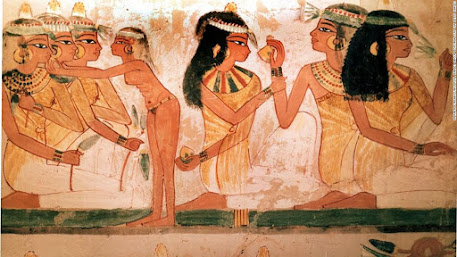
  ANCIENT EGYPT BEAUTY AND COSMETICS Ancient Egyptians paid especial attention to hygiene. Thet bathed regularly and took great care of their skin,polishing it with pumice stone and using creams, ointments and soaps. Did you know they had wrinkle preventing creams?  Or scar treatments? Moreover, they had other cleanliness- related products such as deodorants, toothpaste or perfumes  (remember these weren't generally used in Europe until  the14th century). Remember the desert heat? Egyptians came up with a solution to it while also fulfilling hyenic purposes: shaving their bodies and heads.  WIGS Although it wasn't strictly necessary (you could go out with your shaved head and it wasn't badly considered), Egyptians liked to put on wigs, which they decorated with  great passion and care. Elaborated hairstyles were designed by braiding its hair, alternating jewels, flowers or beads. Married women used to wear a triparti style , in which the hair was divided in...

Ancient Egypt: Part 1

Imagen
  Ancient Egypt Let's start with a great ancient kingdom: Egypt, the Land of the Pharaohs (3100 B.C - 31 B.C.).Situated in Northeast Africa, this civilisation grew along the Nile River and it is best known for the construction of the Pyramids of Giza (which weren't built by slaves btw), the mummification process carried out after someone's death, hieroglyphics or royal figures like Nefertiti, Cleopatra or Tutankhamun. FASHION: COSTUMES Fashion always meets the place's needs where it's developed. Therefore, as Egyptians lived in a territory surrounded by the desert, they fabricated light clothing to deal with the hot climate. Clothing was made out of white linen, which was obtained from flax, a plant that grew near the river's shore. Besides, people were often bare chested. MEN At first, working men wore loincloths, but then appeared the  shenti , a type of skirt that was tied around the waist with a belt.     Tomb of Ramesses I. Both gods and pharaoh are we...

An Introduction...

Imagen
Hello everyone! After thinking for a while about what I wanted to talk about I came up with this blog's theme. There were lots of topics to choose from, but I couldn't decide. Since I like History I thought: 'why not looking at it from a different perspective?' Fashion has changed throughout the ages, according to social standards, beauty models and periods' necessities. Along this blog's posts my hope is to learn and show you a beautiful part of History not often acknowledged but, from my point of view, very interesting. I will try to keep it simple: it's a very specific topic and I want us both (me and you, reader) to understand it. So I hope you'll like this blog's content and even if you are not very interested in this subject you can always scroll down the screen and take a look at the marvellous fabrics and jewellery ancient people used to wear 💫. And...that's it! I'm planning on focusing mainly on ancient civilisations ( such as Egypt...